


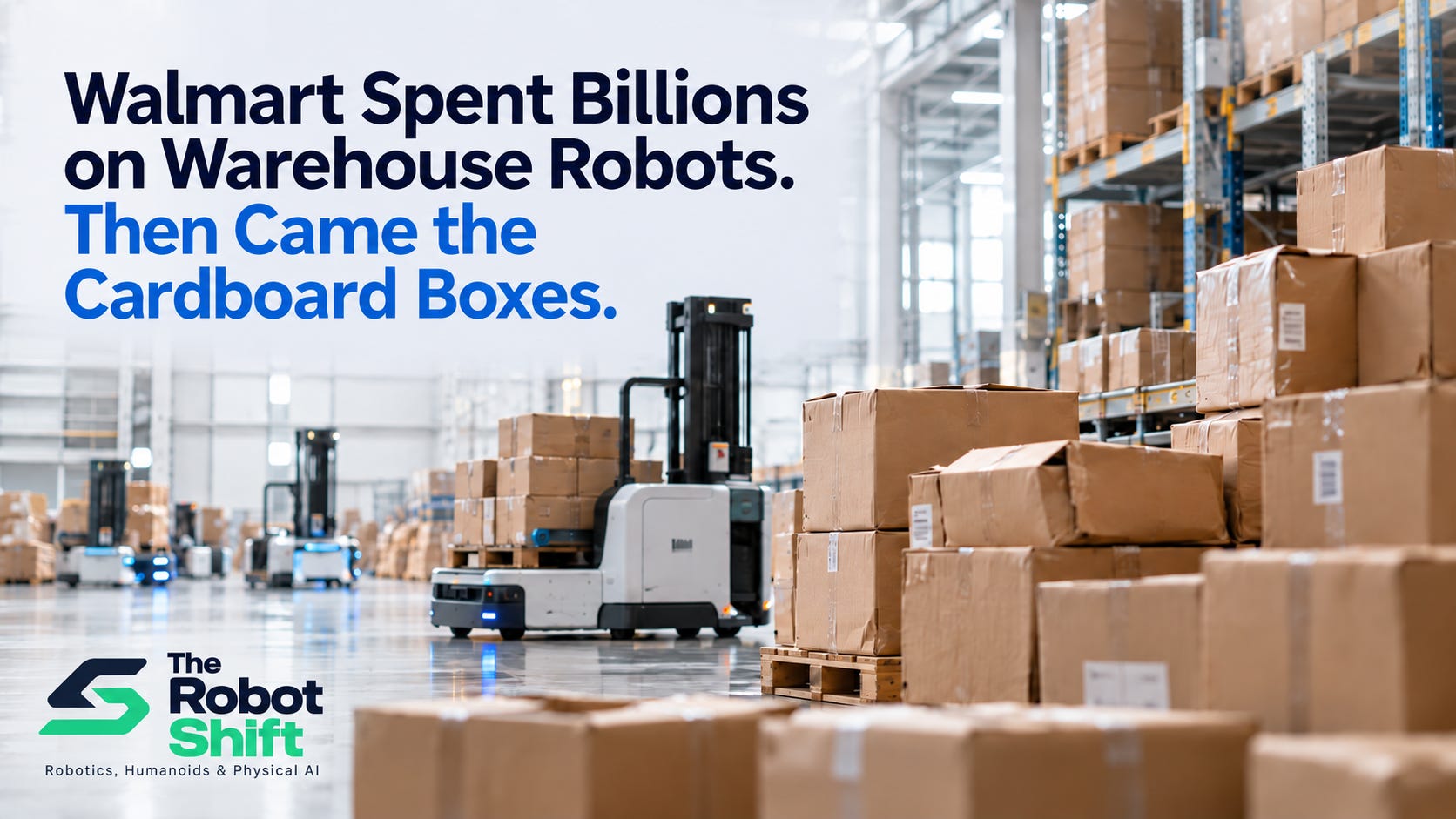
Walmart has spent billions automating its warehouses. Yet some of its toughest challenges involve cardboard boxes, dog food and frozen turkeys.
That may sound almost comical. But a recent Wall Street Journal investigation reveals an important lesson for anyone investing in logistics robotics: automating a warehouse is not the same as making every warehouse task easy to automate.
The last 20% is proving difficult
Walmart has made genuine progress. According to the reporting, more than 65% of its US stores were receiving at least some automated freight by August 2026. At its Brooksville, Florida, distribution center, roughly 80% of inventory movements are automated.
But the remaining tasks can be stubbornly difficult.
Oversized bags of pet food, large televisions and other irregular items still need manual intervention. Human workers instinctively adjust their grip or approach. Robots require the right grippers, sensors, programming and recovery procedures.
And a system designed to process standard cartons can struggle when the carton—or its contents—doesn’t behave as expected.
For executives, the question isn’t simply how much can be automated. It’s how much handling, disruption and expense remain in the exceptions.
When the operation must adapt to the robot
One particularly revealing example involves Walmart’s reusable merchandise boxes.
Its automated equipment cannot accommodate some of the original containers, according to the WSJ. Walmart is therefore introducing versions approximately 1.5 inches shorter, with additional taping requirements.
That adjustment may seem minor. Across a huge network, however, packaging changes can affect suppliers, handling methods and store operations.
Walmart also sees potential downstream benefits, including faster shelf stocking. The proper evaluation must therefore be end-to-end—not merely whether a box fits a robot.
Then there are the frozen turkeys.
When robotic arms struggled with large birds ahead of Thanksgiving, Walmart reportedly sought reinforced packaging and relied on alternative distribution arrangements.
The underlying lesson is serious: robotics projects can shift costs and complexity upstream to suppliers or downstream to stores. Those effects belong in the business case from day one.
The real costs go beyond the robots
Energy, maintenance, technical staffing and facility modifications all matter.
The WSJ reported that electricity bills at some automated grocery facilities could reach $800,000 or more during peak heating or cooling months, compared with approximately $250,000 in more manual operations.
Those figures aren’t a controlled comparison of robot electricity consumption. Facility size, refrigeration, weather and operating conditions also influence the bill.
Nevertheless, they underscore why equipment-level productivity figures are insufficient.
Retrofitting older distribution centers presents another challenge. A robotics solution may operate beautifully in a purpose-built warehouse yet prove significantly more complicated to install inside an existing facility that cannot pause customer deliveries.
A sound investment case must measure total cost per unit handled, including exceptions, downtime, maintenance, utilities and manual backup—not just robot throughput.
Walmart isn’t abandoning automation
None of this means Walmart’s strategy has failed.
In October, the company announced a next-generation fulfillment center in Stockton, California, where automation is designed to reduce a traditional 12-step fulfillment process to five steps.
That’s the other side of the story: Walmart continues investing because it believes substantial efficiency gains are achievable.
Both things can be true.
Robotics can improve throughput, accuracy and productivity, while delivering those gains across a complex distribution network takes longer, costs more and requires more operational redesign than anticipated.
What does this mean for Physical AI and humanoids?
This is where Walmart’s experience becomes particularly interesting.
The promise of Physical AI is greater adaptability. Robots capable of recognizing unfamiliar objects, adjusting their handling and recovering from unexpected situations could reduce the need to engineer every product and process around rigid automation rules.
Humanoids offer a related possibility: performing different tasks in environments already designed for human workers.
But flexibility doesn’t automatically translate into financial viability.
A humanoid capable of handling a frozen turkey in a demonstration still needs to prove it can work safely and reliably, at useful speed, throughout an entire shift—and at a competitive cost.
The Robot Shift’s Take
Walmart’s experience is neither an obituary for warehouse robotics nor an advertisement for humanoids.
It’s a reminder that the real value of automation isn’t measured by how impressive the technology looks, but by how reliably it operates, how many exceptions it can handle and what economic benefits it ultimately delivers.
The most impressive robot isn’t necessarily the most useful.
The winner may simply be the one that gets through the shift without needing a human to rescue the turkey.
What’s your experience?
Are companies underestimating the hidden costs of warehouse automation? Or are these simply the growing pains of a technology that will eventually transform logistics?
Share your thoughts in the comments or write to robotshift@gscc.co.
Discover our publication and communities at www.robotshift.media.
The Robot Shift — Robotics, Humanoids & Physical AI. China intelligence. Global perspective.