



Welcome to the second edition of The Robot Shift Digest.
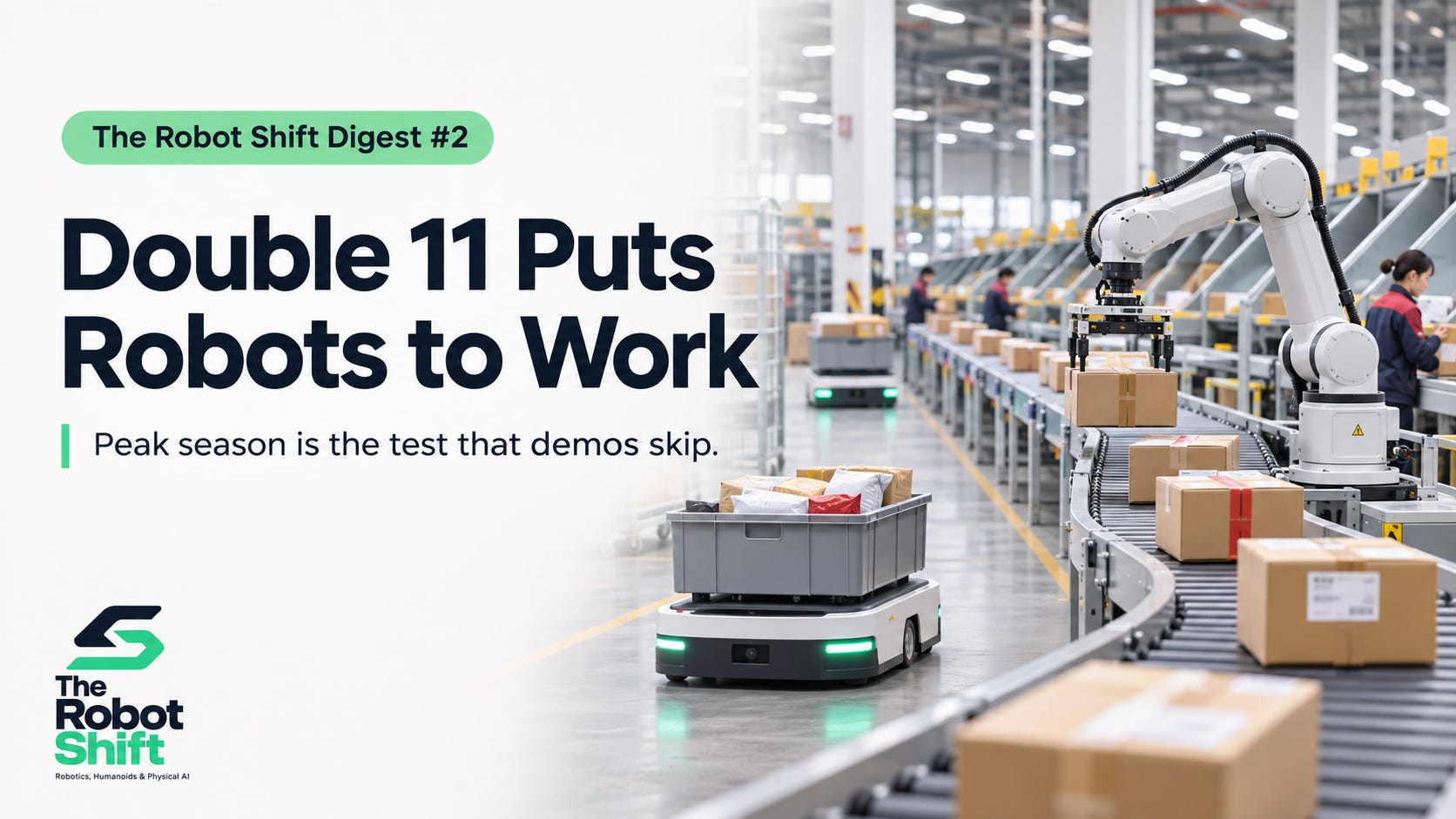
Two scenes from the past two weeks show the gap we track. In Hangzhou, a new humanoid lost part of a leg during a kung fu demo. The next day, its maker’s shares closed up 20%. Meanwhile, across China, embodied robots started their first peak season on express sorting lines, with no audience.
We care about the second scene. Here is what happened, and what it means for your operation.
1. China: Double 11 puts embodied robots on the sorting line
China’s express carriers are in their busiest weeks of the year. The first Double 11 peak day came on October 23. For the first time, embodied robots are working express sorting at scale, National Business Daily (每日经济新闻) reports.
Here is what the Chinese press says:
STO: embodied robots now sort parcels at core transfer centers in Zhejiang and Jiangsu, around the clock. STO joins SF, which already runs them. Neither disclosed unit counts.
ZTO: 3,515 unmanned vehicles deliver an average of 4 million parcels a day across 268 cities, as of October 15. That works out to about 1,140 parcels per vehicle per day.
JD Logistics: JD has deployed its Wolf robot family across the network for the peak, including a dexterous robotic arm that sorts parcels in warehouses. JD says its couriers follow AI-recommended routes more than 90% of the time.
A franchise outlet in Hebei: it bought 11 unmanned delivery vans, eight from Neolix and three from Zelos (九识). One rural route went from six drivers to one.
Our take: Double 11 is the stress test. Volume spikes, parcels vary and nobody has time to reset a robot. The carriers have announced deployments, not results. We will ask for the numbers at CeMAT this week and report back.
Read the reports (in Chinese): National Business Daily → | Xinhua →
2. The number: 794,781
China produced 794,781 industrial robots in the first nine months of 2026, up 29.1% year on year, according to the National Bureau of Statistics. September alone added 96,752 units, up 18.9%.
For scale, the International Federation of Robotics counted 354,000 industrial robots installed in China in all of 2025. The two figures measure different things. One counts robots made, including those shipped abroad. The other counts robots installed.
Our take: Output growing near 30% a year will need buyers outside China. If you run operations in Asia, the Middle East or Europe, expect more Chinese vendors at your door and sharper price competition. Your constraint is not supply. It is integration capacity and people who can run these systems.
3. Deployed: GXO adds two Digit sites, but no payback yet
In our first edition, we featured Agility Robotics’ Digit humanoid and the 100,000 totes it has moved at a GXO site in Georgia. On October 26, the two companies expanded the deal.
Digit goes to two more GXO e-commerce fulfillment sites, in North Carolina and Tennessee.
The companies expect deployments to start in early 2027 with Digit 4. GXO plans to switch to Digit 5 once it is commercially available.
The deal runs as robots-as-a-service. Neither company disclosed robot counts or contract value.
Agility reports more than 65,000 hours of real-world operation.
GXO has run 45 humanoid pilots, with another starting soon in Europe.
Agility is heading to Nasdaq through a merger with Churchill Capital Corp XI, expected to close this quarter.
The most useful line came from GXO’s own CEO, Patrick Kelleher, on the company’s August earnings call: “We have not achieved ROI on humanoids yet.”
Our take: Credit to GXO for saying it plainly. Expanding before payback is a bet on the next model, not proof that the current one pays. For a 3PL that wants to learn early, that is a fair bet. If you are not GXO, wait for the numbers that matter: robots per site, hours per robot and interventions per shift.
4. Physical AI: Otto Group bets on robots for returns
On October 30, Otto Group and Stuttgart-based Sereact announced a phased robot rollout at an Otto Group logistics center in Poland. AI-driven, two-armed robots will inspect and sort returned orders.
Phase one: 10 systems.
Phase two: 15 more, only if phase one delivers, for up to 25.
Sereact’s Cortex model lets the robots handle items they have never seen, with no product-specific teaching.
Sereact runs and maintains the robots as a service. Staff move to supervision, exceptions and quality checks.
Neither company disclosed throughput, error rates or pilot results.
Three weeks earlier, Sereact robots started sorting Zalando returns at CEVA Logistics sites in Greven, Germany, and Świebodzin, Poland.
“Returns are notoriously hard to automate, and Physical AI has the potential to change that,” said Martin Umland, Group Vice President Supply Chain Management at Otto Group.
Our take: Fixed automation struggles with returns because no two items arrive the same way. Two of Europe’s largest online retailers chose the same approach within a month. Note the contract shape too: a small first phase, then expansion only on results. That is how to buy physical AI.
5. Humanoid Watch: a fall, a production line and a prototype
Three humanoid headlines from the past ten days, and what they tell an operator.
Unitree, Hangzhou: Unitree unveiled its H2-X humanoid on October 21, aimed at security and emergency rescue. The next day, at Unitree’s first partner summit, the robot stumbled during a kung fu demo. It lost part of a leg after a failed side flip, the Global Times reported, citing footage circulating online. On October 23, Unitree’s shares closed up 20%. Founder and CEO Wang Xingxing said embodied intelligence could reach its “ChatGPT moment” as early as next year.
Tesla, Fremont: Tesla has started producing Optimus at its California factory and calls the units its “first production-quality bots.” Elon Musk called it “early production” and expects a “somewhat bumpy” ramp. He claimed Tesla will be able to make 20,000 robots a week by the end of 2027. He also said the AI still needs substantial work before Optimus is useful for open-ended tasks.
Meta, Shanghai: Meta built a humanoid prototype called Max with Chinese maker Fourier in about three months, according to The Information. A Meta vice president spent nearly two months at Fourier’s Shanghai factory. Meta says the work is for internal research and the robots are not for sale. The report does not address the FCC’s July move to ban imports of new foreign-made humanoids.
Our take: None of the three said anything about payback in a warehouse. One pattern stands out: when even Meta needs humanoid hardware fast, it goes to Shanghai. Judge humanoids on hours worked, not headlines made.
Read more: Global Times → | TechCrunch → | Investing.com →
6. Robots in Action: two videos worth watching
Sereact at CEVA, for Zalando (Germany and Poland)
A 66-second film from Sereact shows two-armed robots unfolding, checking and repacking returned garments. It is a vendor film, so expect polish. The footage is real, not animation. Watch on YouTube →
JD Logistics Zhilang tote-to-person system (China)
JD’s official 95-second film on its Zhilang (智狼) tote-handling robots. The first minute is animation. Skip to 1:02, where the label 仓库内实拍 (”filmed inside the warehouse”) marks real footage of the robots at work. Watch from 1:02 →
Announcing The Robot Shift Awards 2027
Many awards reward launches. Ours reward work.
The Robot Shift Awards recognize robots and physical AI doing real work in supply chains. Four rules set them apart:
A robot qualifies only after at least 90 days in production at a real customer site.
Entries include operating data the customer confirms, plus unedited video from the site.
End-user logistics and operations leaders form the core of the jury. No vendors, consultants or investors sit on it.
No entry fees, no paid places on the shortlist, no gala tables.
The six categories: Deployment of the Year, Humanoid at Work, Cross-Border Deployment, Startup at Work, Enabling Technology and Operators’ Choice.
Entries open on Tuesday, December 1, 2026, and close on Sunday, February 28, 2027. We announce finalists on Tuesday, April 13, and reveal the winners on Thursday, May 20.
Do you run logistics or warehouse operations? Apply to join the jury.
Register your interest at robotshift.media/awards →
Coming up: China Field Notes from CeMAT Asia
I will be at CeMAT Asia in Shanghai on Wednesday, November 4 at the Shanghai New International Expo Centre. My questions for exhibitors are simple:
Which customer runs this robot in production, and for how long?
What is its throughput per hour, compared with a trained operator?
How often does a person step in?
What did Double 11 teach you?
If you are exhibiting and can answer with real data, write to me at mh@gscc.co. It is also the right moment to tell me about a deployment for the Awards. Field notes follow in Digest #3.
Join The Robot Shift community
Swap news, videos and deployment stories with professionals worldwide in our WhatsApp group. Based in China? Join our WeChat group through the QR code at robotshift.media.
Quick poll
What would it take for you to deploy a humanoid in your operation?
Verified throughput close to a trained operator
Payback in under three years
A reference site in my industry
Robots-as-a-service pricing with no upfront investment
Nothing yet. The technology is not ready.
Vote, or reply to this email and tell me why.
The Robot Shift is published by the Global Supply Chain Council (GSCC). See what members get at https://gscc.co/benefits, browse upcoming events at https://www.chain.net/c/events/ and continue the discussion with supply chain peers at https://www.chain.net/c/ask.
Until next time, keep watching the robots. Preferably the ones doing useful work.