


Welcome to the first edition of The Robot Shift Digest, where we explore the robotics, humanoids and Physical AI developments transforming global supply chains.
There’s plenty happening. China is testing humanoids in major parcel facilities, robotics companies are developing new ways to train machines, and warehouse automation continues to deliver measurable results across international markets.
But here’s our starting principle: impressive videos are interesting; operational performance is what matters.
Let’s get into it.
1. 🇨🇳 China Post: Humanoids are working, but humans remain faster
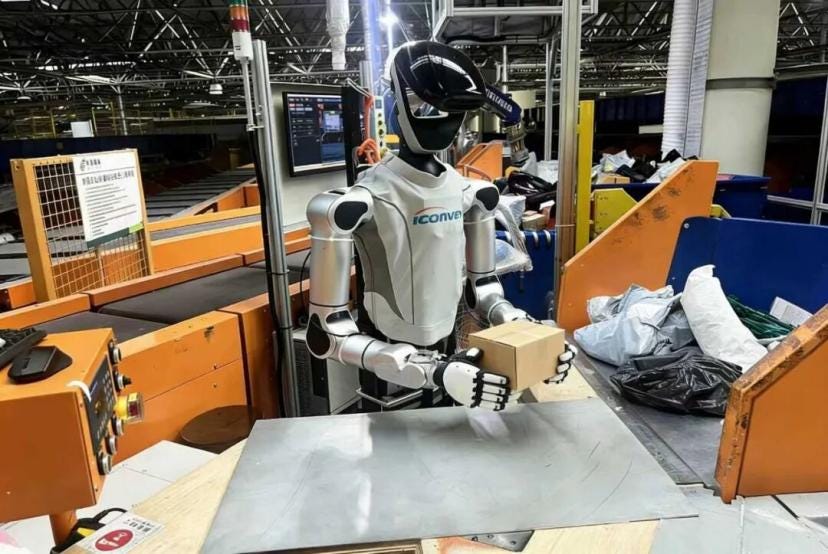
One of the most interesting real-world humanoid trials is taking place at China Post’s Jianggao processing facility in Guangzhou.
Eight humanoid robots have been tested feeding parcels onto sorting lines since March.
The numbers are revealing:
800 parcels/hour: Reported sustained robot feeding rate.
1,200 parcels/hour: Peak achieved after training and adjustments.
1,600–1,800 parcels/hour: Typical human-worker rate reported by the facility.
China Post hopes to increase the robots’ performance to approximately 1,600 parcels an hour by the second quarter of 2027.
That’s genuine progress. But it also raises an important question: even if the robots eventually match human throughput, will the economics justify their deployment?
Reliability, maintenance, human interventions and total operating costs will be just as important as speed.
Our take: This is exactly the kind of deployment we want to follow. Not because robots have replaced workers, but because we can finally start measuring their capabilities against actual operating requirements.
2. 📊 The number: 117,500 logistics robots sold worldwide
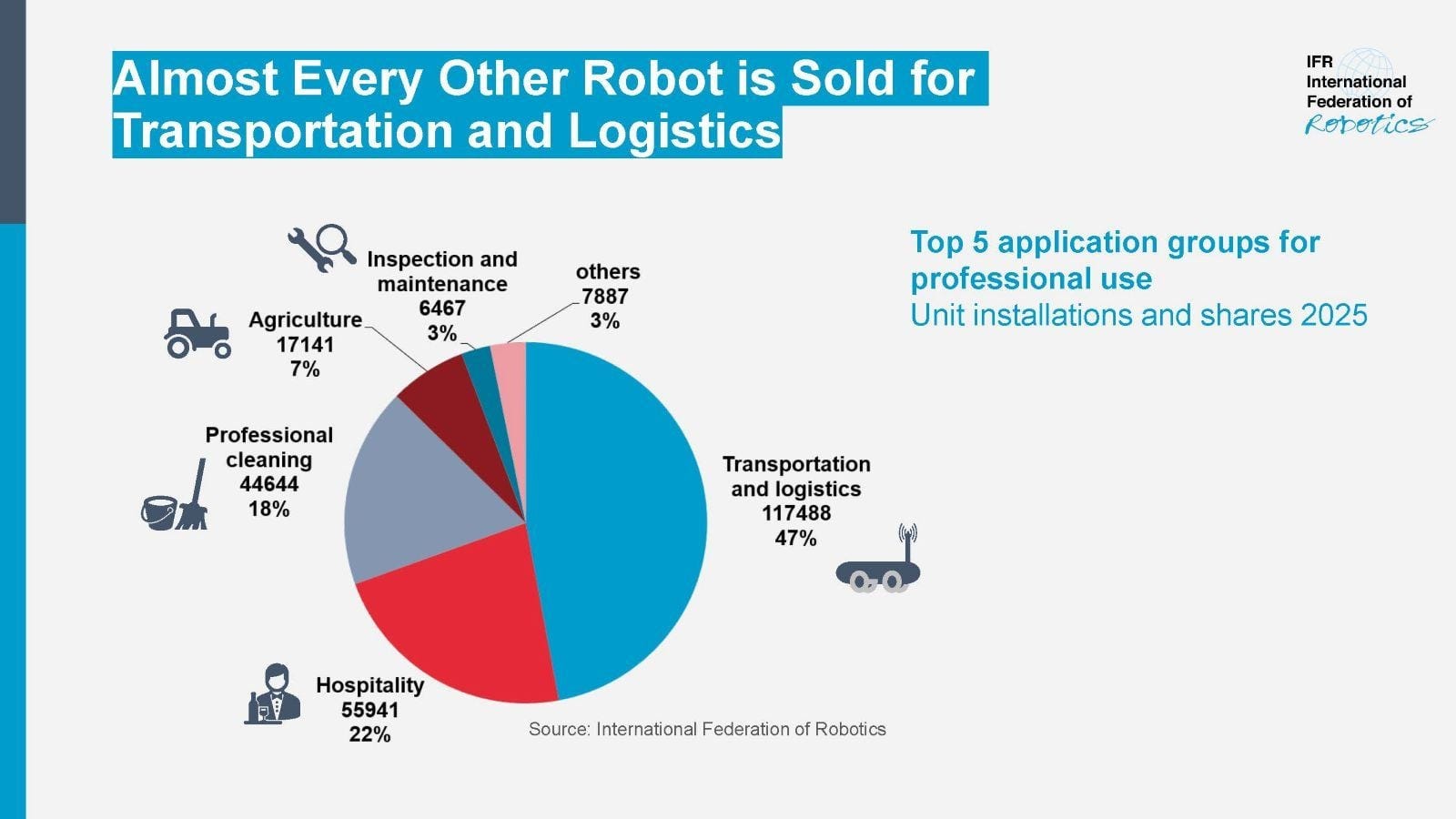
The International Federation of Robotics has released its World Robotics 2026 service robot figures.
The headline? 117,500 professional service robots were sold for transportation and logistics applications in 2025, up 21% year on year.
That represents approximately 47% of the professional service robot market.
And there’s another interesting comparison: IFR estimates that about 7,000 full-size humanoids were sold globally in 2025.
While humanoids attract much of the attention, conventional logistics robots are already selling in far greater numbers.
Our take: The robotics revolution isn’t waiting for humanoids. AMRs, automated material-handling systems and specialized machines are already transforming operations.
The opportunity will increasingly be to understand where humanoids complement those systems—not automatically replace them.
3. 🇨🇳 Physical AI: Hesai wants to give robots a better understanding of the world

Chinese technology company Hesai unveiled Kosmo on October 14, a new platform combining a spatial camera with cloud-based 3D reconstruction technology.
The objective is to capture high-quality real-world environments that can be used to train robotics systems and develop Physical AI models.
Why does this matter?
One of the biggest challenges facing intelligent robots is getting enough relevant training data from unpredictable real environments.
Warehouses, factories and logistics facilities contain different layouts, objects, lighting conditions and unexpected obstacles.
Giving robots access to richer spatial data could help developers train systems that adapt more effectively.
Hesai has announced partnerships with robotics companies including Galbot and Dexmal.
Our take: Some of the most important Physical AI innovations may come from the companies developing sensors, actuators and training infrastructure—not just the manufacturers producing humanoid robots.
The technology is promising, but a product launch is not evidence of higher warehouse productivity. That still needs to be demonstrated.
Discover Hesai’s Kosmo platform →
4. 🇳🇱 Real deployment: 127 robots transforming fashion fulfillment
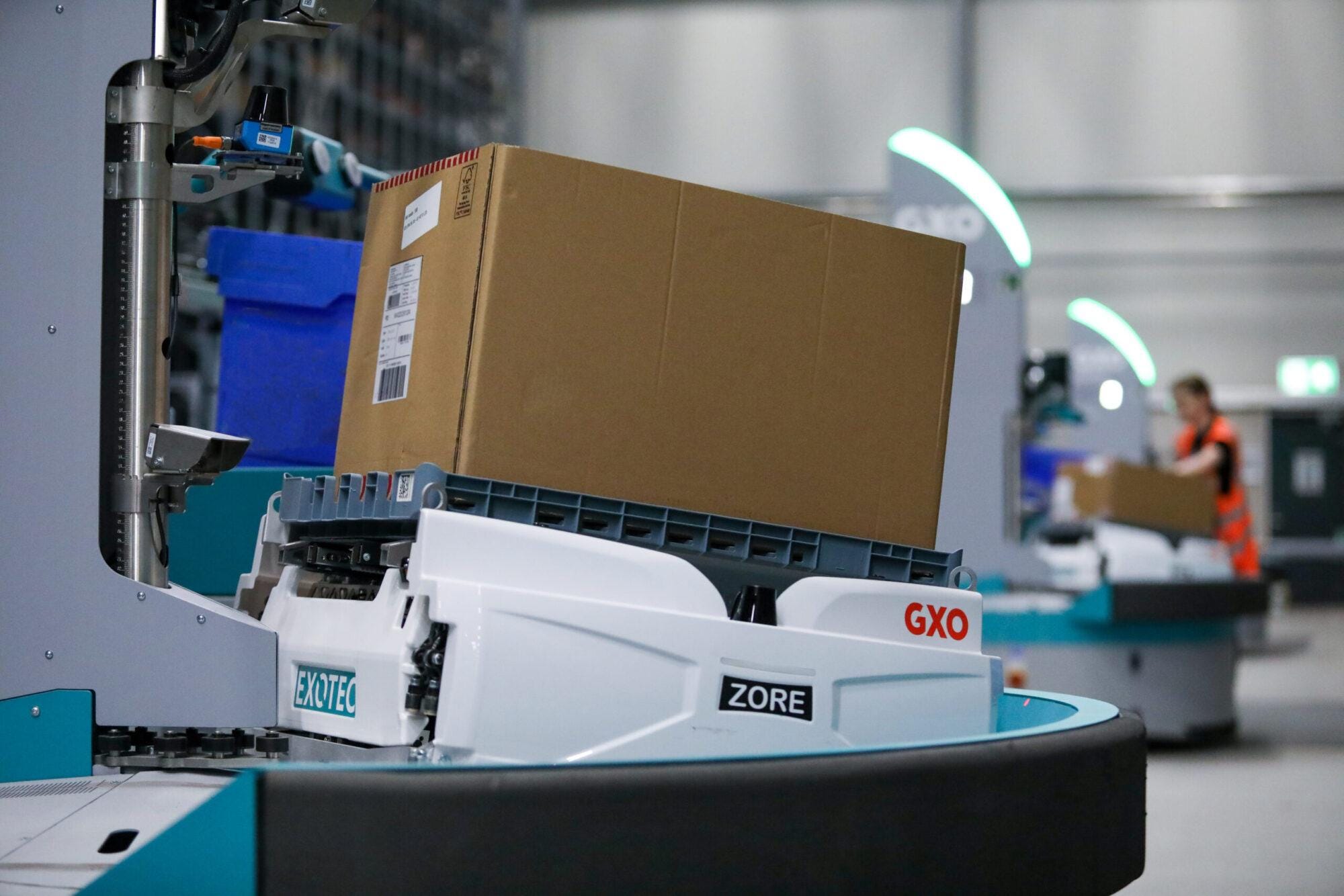
Away from humanoid demonstrations, GXO Logistics and French robotics company Exotec have announced the deployment of a Skypod automation system serving Guess at a logistics facility in Venlo, the Netherlands.
The installation includes:
127 robots and 60,000 storage locations.
Eight goods-to-person picking stations.
Approximately 200 meters of conveyors.
Reported processing volumes of 40,000–70,000 items daily.
Peak throughput capability of 2,200 order lines/hour.
This is a particularly interesting deployment because fashion fulfillment involves large SKU portfolios, seasonal peaks and changing demand patterns.
Our take: This is what mature warehouse robotics looks like: an integrated operating system designed around the customer’s requirements, rather than an impressive individual machine.
For supply chain executives, those measurable capabilities are more useful than another futuristic demonstration.
Read the deployment announcement →
5. 🤖 Humanoid Watch: Agility’s Digit provides a useful benchmark
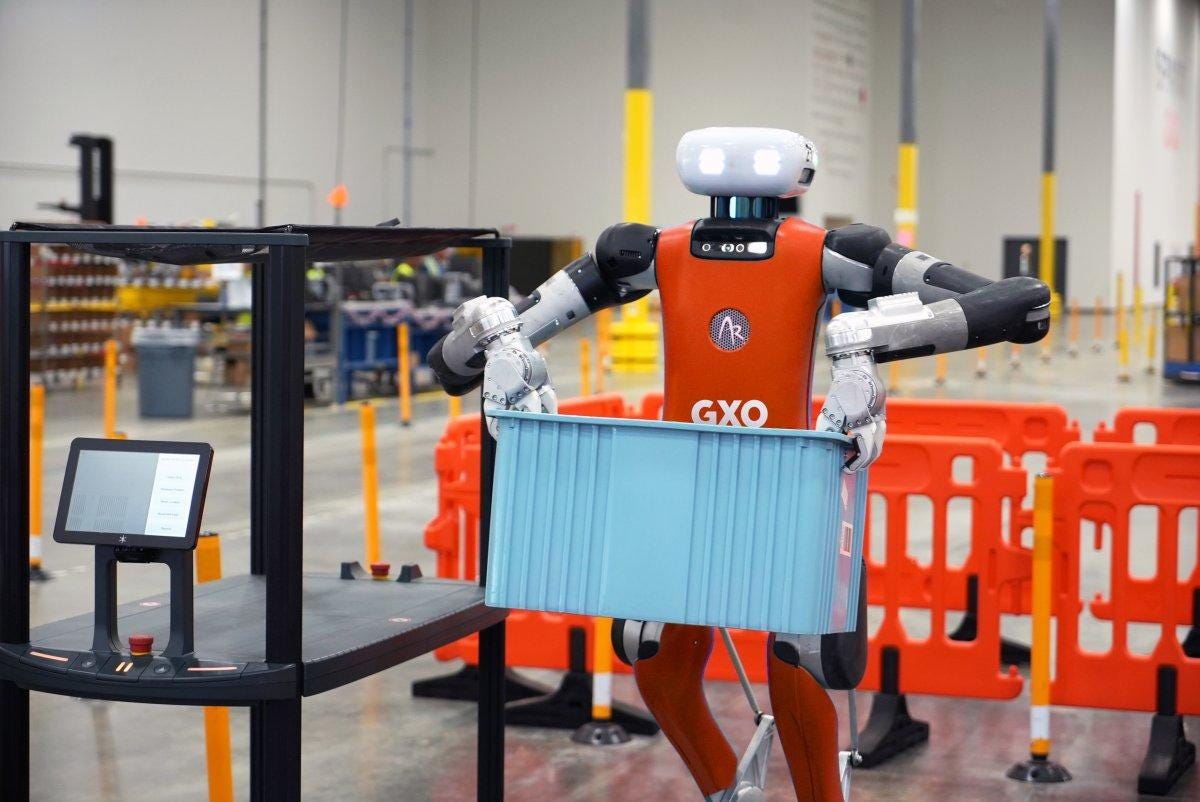
While Chinese humanoid manufacturers attract growing international attention, US company Agility Robotics offers an important operational reference.
Its Digit humanoid has been deployed commercially at a GXO logistics facility in Georgia, working with other automation equipment on tote-handling tasks.
Agility reports that Digit has moved more than 100,000 totes at the facility.
That’s a meaningful cumulative operating milestone, although the figure alone doesn’t establish hourly productivity, uptime or return on investment.
Our take: Humanoids will become more interesting as vendors publish operating histories, intervention rates, safety performance and customer-validated economics.
And the real test isn’t whether Digit—or any other humanoid—can move a tote. It’s whether it can do so reliably enough to justify its cost against alternative automation.
Explore the Digit deployment →
6. 🎥 Robots in Action: Two videos worth watching
Geek+’s Gino humanoid — Japan
Chinese warehouse robotics company Geek+ recently showcased its Gino humanoid and integrated warehouse automation technologies at Logis-Tech Tokyo.
Japanese business media PIVOT published a detailed video on October 2 examining whether humanoids are ready for practical logistics applications. The Geek+ demonstration begins around 03:22.
This is a technology demonstration, not proof of a scaled commercial deployment.
Watch the Geek+ demonstration and discussion →
Check out the Linkedin announcement as well here.
Hai Robotics at Lenovo — China
For a different perspective, watch Hai Robotics’ case video of an automated logistics operation at Lenovo’s Wuhan facility.
The supplier reports 61 robots, throughput of 536 boxes per hour and a 40% increase in storage capacity.
These are manufacturer-reported performance figures, but the footage illustrates how established robotics can be integrated into actual industrial logistics processes.
Watch the Lenovo warehouse automation video →
Coming up: China Field Notes
I’ll be attending CeMAT Asia in Shanghai on November 3, looking at the latest warehouse robotics, automation systems and emerging Physical AI applications.
I’m particularly interested in speaking with manufacturers and operators who can show real deployments, operating data and practical applications—not simply another carefully rehearsed demonstration.
If you’re exhibiting or have an interesting technology worth discussing, feel free to get in touch at mh@gscc.co
Join The Robot Shift community
The Robot Shift isn’t just a publication. We’re building a global community of people interested in how robotics and Physical AI are changing supply chains.
Join our global WhatsApp discussion group to exchange ideas, news and videos with other industry professionals.
You can also explore our other channels at robotshift.media.
And one question before you go:
Where do you see humanoid robots delivering real commercial value first: manufacturing, warehousing, logistics or something else entirely?
Reply to this edition and share your thoughts.
Until next time, keep watching the robots. Preferably the ones doing useful work.
Max