



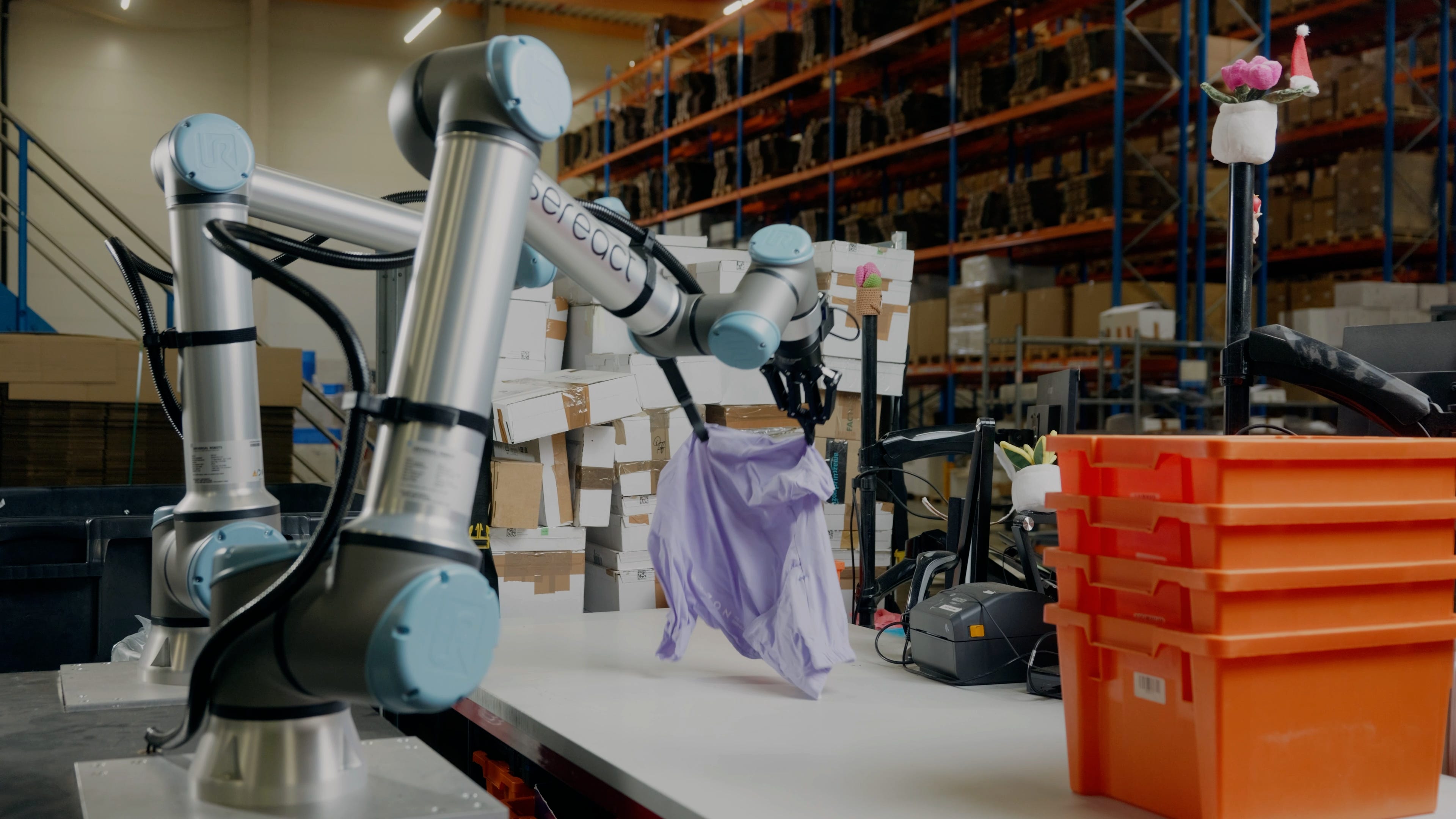
If you wanted to design the worst possible task for a warehouse robot, you would invent returns.
Every item arrives in whatever state the customer left it. Refolded or crumpled. In its polybag or loose on the floor of a box. Tags attached, tags cut off, tags in the bottom of the carton. The robot has to pick it, identify it, assess its condition and sort it. Then the assortment changes next season and much of what it learned goes stale.
Now run that at Zalando volume, where roughly half of all orders come back.
Recently, Sereact, NVIDIA, Nebius, CEVA Logistics and Zalando announced a closed training loop for Sereact’s Cortex robot brain, with the first deployment handling Zalando returns at selected CEVA fulfillment centers. Dual-arm stations pick, identify and sort. The claim that matters operationally is this: what a robot gets wrong on Monday can come back as a tested policy update within days, where it used to take weeks.
That is a genuinely different development cycle. Whether it translates into a different cost per unit is the open question.
How the loop actually works
The architecture is specific enough to evaluate, which is more than most robotics announcements offer.
Episodes from the returns stations, meaning video plus robot kinematics, land in Nebius object storage. NVIDIA Isaac Lab turns those real episodes into thousands of simulated variants. Cosmos world foundation models re-render them across garment states, packaging types, materials and lighting conditions. The versioned dataset post-trains Cortex on Blackwell GPUs. The new policy is scored against held-out variants, and a passing policy goes to physical stations for real-world testing. A failing policy triggers targeted variants for the cases it missed, and the loop runs again.
An AI agent orchestrates the pipeline, previews GPU cost before each run and decides which cases to augment after a failure. Engineers state the goal, such as validating a policy for the autumn assortment, and approve runs above a cost limit.
The core insight here is worth understanding even if you never buy this system. Real picks only cover items that have already passed through a station. The bottleneck in robotic learning was never the algorithm, it was exposure to variety. Simulation multiplies one real episode into thousands of synthetic situations, which is how you cover a product range you have not yet received.
The economics nobody has published
Here is what the announcement does not contain. Sustained throughput figures. Exception rates. Product damage rates. Cost per unit processed compared to the manual line it replaces. Intervention time per shift.
Faster training is an input metric. None of the output metrics are public.
That gap matters because returns processing has a brutal economic profile. The margin on a returned garment is thin or negative before you touch it. Automation only pays if it moves units at a cost per touch below the manual alternative, with a damage rate that does not eat the recovered value.
James Darnell, a global supply chain and operations executive, makes the right comparison. Returns at that volume are a manufacturing problem running in reverse. He points to remanufacturing, where core returns get inspected, sorted and graded before anything moves, and where the economics turn on disposition speed. Returns processing is catching up to that logic, he notes, with one disadvantage. Worse data at the door.
That last phrase is the crux. A remanufacturer knows what is in the crate. A returns operation often does not know what is in the bag until something opens it.
Three things that decide whether this scales
Exception handling, not nominal throughput. A station that handles 92% of items cleanly and jams on the rest has not removed the labor, it has relocated it. The question for any operator evaluating this class of system is what happens to the 8%, who touches it, and how fast the cell recovers. Vendors quote picks per hour. Buyers should quote units out the door per shift, including everything the robot handed back to a person.
Integration into the wider process. Sher Ali, who works in e-commerce fulfillment and 3PL, identifies the failure mode. Returns create enormous operational friction when inspection, sorting and inventory updates do not happen efficiently. Automation makes a real difference when built into the warehouse process rather than treated as a standalone solution. A robot that sorts beautifully but does not write back to inventory in real time has improved one station and left the restocking delay untouched.
Seasonal drift. The assortment changes every season. That is not an edge case in fashion, it is the operating condition. The loop is designed precisely for this, which is the strongest argument in its favor, and also the thing to verify. Ask how performance held up through a full assortment transition, not a stable month.
Why this took so long, and why now
There is a useful observation circulating in the robotics community about why ordinary tasks resisted automation for decades.
Folding laundry. Opening a door. Picking up a cup. A child does these without thinking, and when a robot manages it the internet celebrates. The irony is that what is effortless for a child remains one of the hardest problems in robotics, and for a long time there was little commercial reason to solve it. With labor readily available, the business case for automating everyday manipulation was weak.
Ageing workforces and labor shortages changed that calculation. The milestone is not the viral demonstration. It is making these tasks reliable every single day, so robots support stretched teams and free people for work where judgment pays.
That reframing matters for how you evaluate a pilot. Impressive is not the bar. Boring and repeatable is.
What happens to the people on the floor
The reflexive reading is that returns handling is finished as a human activity. People who run these buildings are less convinced.
Hoang Le, who has spent about ten years on the floor across preload, dispatch and cross-dock, makes the operational case plainly. Robots do not run a building by themselves. Someone still watches throughput, catches the AI’s mistakes, and fixes things when a truck shows up late or a lane backs up. What he expects is a mix, robots doing repetitive sorting with people supervising, and the jobs going to those who understand both the floor and the technology running on it. It is only really over, he argues, with a fully lights-out operation that can run and repair itself end to end.
Alan Ng, founder and CEO of Quikbot, holds a similar position. Monotonous repetitive work will be automated in some form. Removing humans entirely will take longer. Structural unemployment, in his view, is here regardless.
Darnell’s version is the most actionable. Automate the sort and inspection where volume justifies it, and keep people where judgment matters.
Two takeaways
First, write your evaluation around exception rate and damage, not picks per hour. For returns specifically, the money sits in disposition accuracy and recovered value. A system that sorts fast and grades wrong destroys more value than it creates. Ask any vendor in this category for exception rate, intervention time per shift and damage rate from a live site across a full seasonal transition. If those numbers do not exist yet, you are funding a pilot, and you should price it as one.
Second, treat the training loop as the product, not the arms. The hardware in this announcement is unremarkable. The defensible asset is the pipeline that turns yesterday’s failures into next week’s capability. When you evaluate competing systems, compare how quickly each one absorbs a product category it has never seen, because that is the variable that decides whether automation survives contact with your actual assortment.
Returns were one of the last genuinely messy corners of e-commerce. They are now the proving ground for whether physical AI works outside a demo.
What percentage of your returns volume would survive automated sorting without human review, and how would you know? And has anyone in your operation measured the true cost per returned unit, including the restocking delay?
Continue the discussion on Chain.NET, the global supply chain community, https://www.chain.net/c/ask. Ask your questions, join events and debates, and see the full member benefits at https://gscc.co/benefits.