



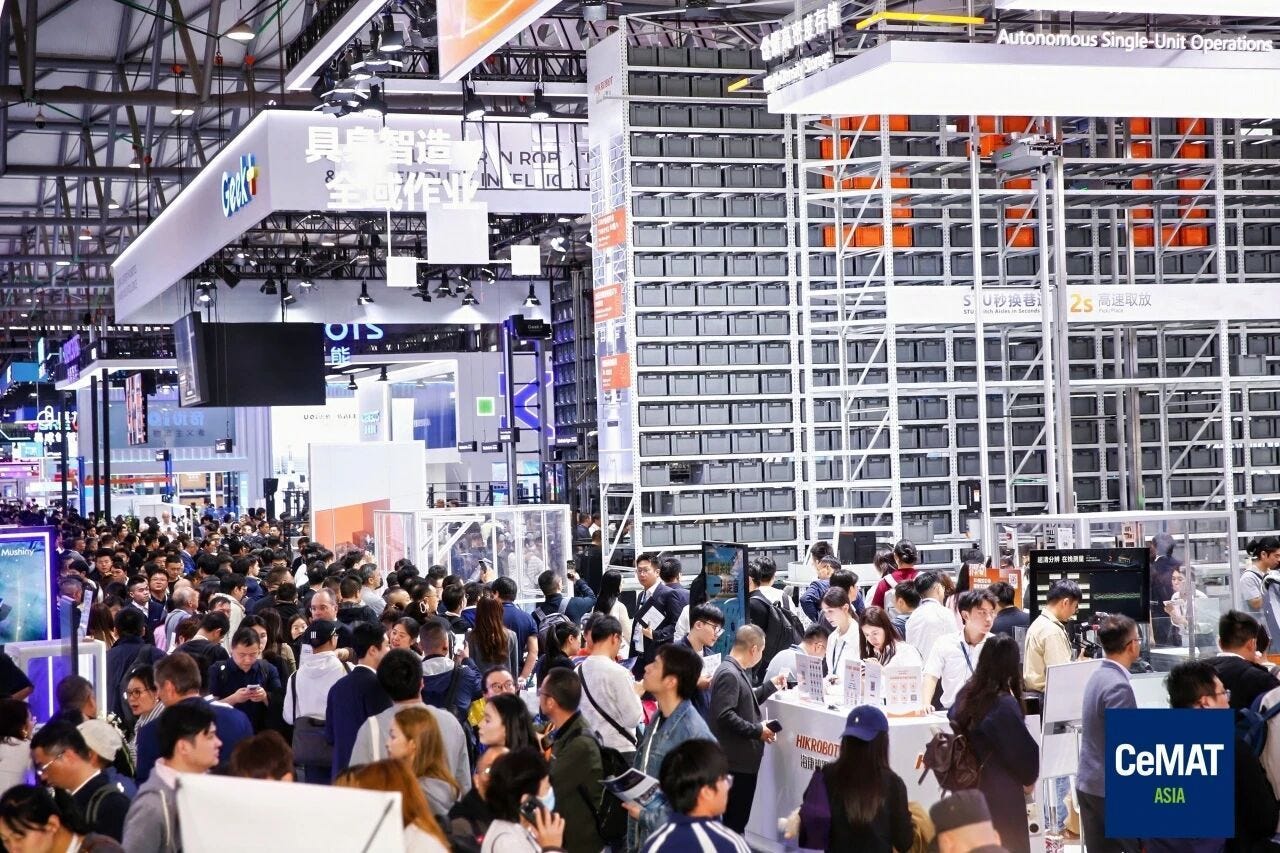
CeMAT Asia was enormous, crowded and packed with robots. Actually evaluating those robots was another matter.
I spent November 4 walking the exhibition halls in Shanghai. The scale of China’s warehouse automation industry was impressive. So was the noise.
Robots were moving, arms were picking, screens were flashing and exhibitors were competing for attention. But having a constructive technical conversation, let alone comparing competing solutions, was surprisingly difficult.
It left me wondering: Is the traditional trade show still the best way to discover and evaluate robotics technologies?
An impressive exhibition, but a difficult buying environment
CeMAT Asia brings together an extraordinary range of warehouse automation technologies. Yet the exhibition layout felt fragmented, with components, individual machines and integrated solutions often mixed together.
For visitors trying to compare competing approaches, that creates unnecessary complexity.
Why not dedicate specific halls or demonstration zones to comparable technologies - AMRs, robotic picking, automated storage, humanoids and warehouse software - with structured demonstrations and quieter meeting areas?
The conference program was another disappointment. The sessions I encountered offered limited independent analysis, with too many exhibitor presentations feeling like sales pitches.
Trade shows are excellent for visibility and networking. But visibility isn’t evaluation, and a crowded booth demonstration is no substitute for understanding how a system performs in a real warehouse.
Warehouse automation is mature. Differentiation is getting harder.
Walking the floor reinforced something we’re seeing across supply chain projects: many warehouse automation technologies have reached a high level of maturity.
Automated storage systems, shuttles, mobile robots, palletizing equipment and high-capacity material-handling solutions were everywhere.
But many offerings increasingly resemble one another.
Chinese manufacturers are also expanding beyond their original specializations. Companies previously associated with a particular robot or storage technology now offer increasingly comprehensive automation portfolios.
With competition intensifying in China, more suppliers are looking internationally for growth.
For buyers, that means more choice and potentially better pricing. But also a more complicated supplier landscape.
And for many smaller operators, the exhibition offered relatively little obvious relief: much of the equipment appeared designed for high-volume operations requiring substantial capital investment.
More products don’t necessarily mean better solutions.
Humanoids on wheels - and the growing importance of integration
Humanoids were difficult to miss. But one feature stood out: many of the more practical-looking systems had wheels rather than legs.
That makes sense.
A humanoid-style upper body mounted on an AGV or AMR platform benefits from established navigation technology, greater stability and potentially longer operating time.
In warehousing, these systems are effectively becoming another type of mobile robot requiring coordination with the wider automation fleet.
Still, many robotic manipulation demonstrations looked relatively slow. The gap between technical feasibility and sustained commercial productivity remains significant.
Meanwhile, digital twins, AI-driven warehouse control and integrated automation were increasingly prominent.
That may be the most important shift.
The competitive advantage is moving beyond individual machines toward how well different technologies work together, supported by software, operational intelligence and reliable integration.
For buyers considering Chinese robotics suppliers, there’s another question worth asking: who actually manufactures the mobile base, joints, drives and other critical components - and who provides service when something fails?
We need a better way to evaluate robotics
After some time at CeMAT, I’m convinced the industry needs more than bigger exhibitions.
Imagine a more practical approach combining curated industry intelligence, an AI-assisted supplier directory with comparable specifications, smaller technology-focused events and guided visits to real operating sites.
Rather than watching ten robots perform ten different demonstrations, buyers could compare them against the same operational requirements.
And instead of another sales presentation, they could hear directly from customers about throughput, uptime, human interventions and actual return on investment.
This is part of what we’re exploring through The Robot Shift: independent coverage, more useful technology comparisons and future robotics innovation tours in China.
Trade shows will remain important. Nothing replaces seeing equipment and meeting people face to face.
But the next step should be helping buyers move from discovering technologies to making better-informed investment decisions.
China clearly has no shortage of robotics innovation.
The bigger challenge now is identifying which solutions deliver real operational value - and which suppliers can support them beyond the exhibition floor.
What was your experience at CeMAT Asia? Are large trade shows still useful for evaluating automation solutions, or do we need a different format?
Share your thoughts at robotshift@gscc.co.
Discover our initiatives and global communities: www.robotshift.media
Siemens and NVIDIA's claim of up to 85 percent less engineering effort at the Siemens Erlangen factory turns out to be a project target rather than a measured result, and an analyst has cautioned it has not been proven at mixed-vendor sites. That is the gap in the sales-pitch sessions you describe: a percentage without the evidence behind it.
A dedicated evaluation zone would help with comparing like with like, but it wouldn't close that gap unless exhibitors had to publish missed-defect and false-reject rates with sample sizes next to the headline percentage, and I'd expect a trade-show floor has little reason to require that. Did any stand at CeMAT show measured results from a live site, or was it all headline figures?