


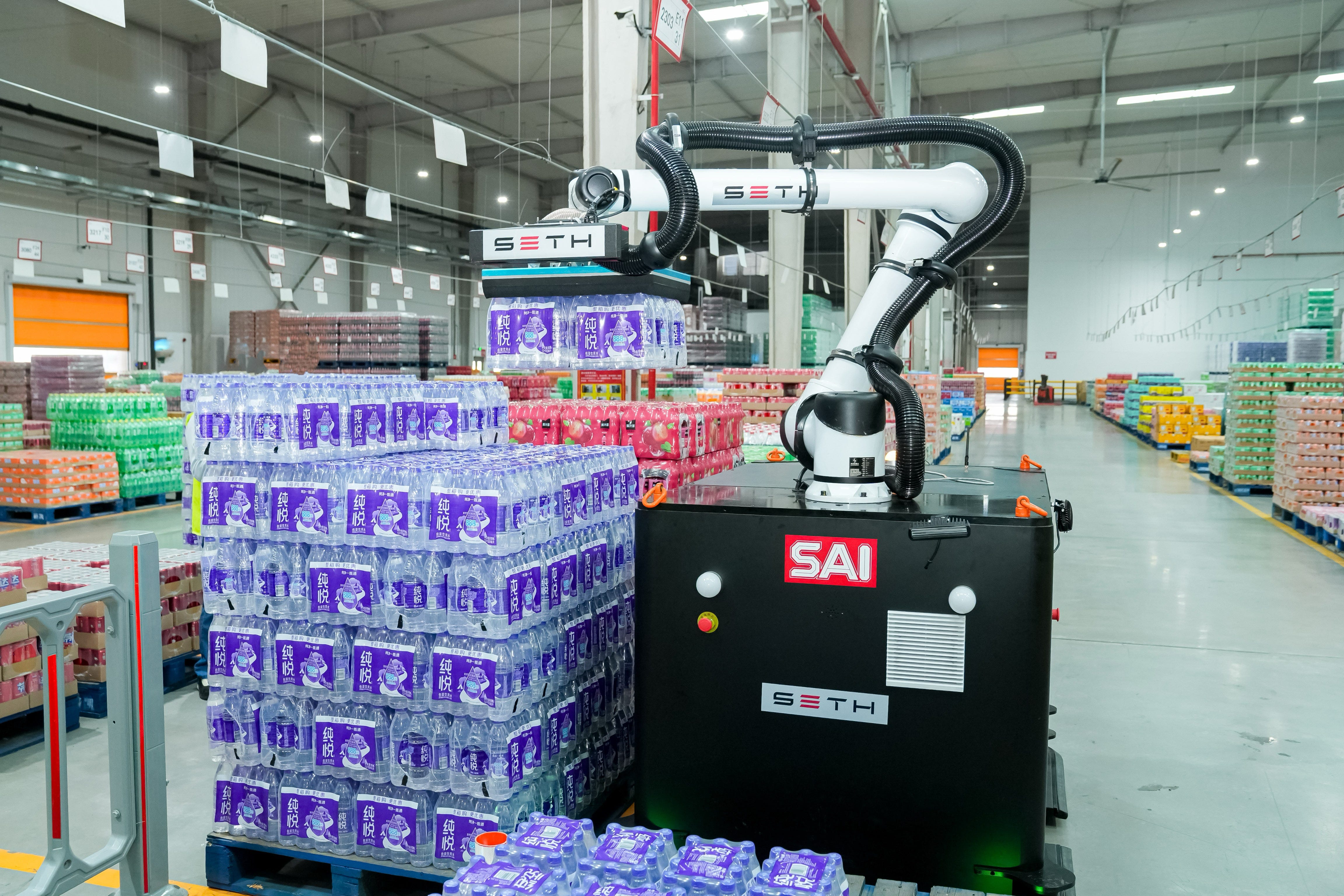
While everyone’s watching humanoid robots learn to dance, Coca-Cola’s bottler in China has robots doing something considerably more useful: picking heavy drinks and building customer orders.
And unlike many impressive robotics demonstrations, these machines are already working in a commercial warehouse.
Swire Coca-Cola has deployed an AI-powered picking and sorting system at its Zhengzhou plant in Henan province, developed with Hangzhou-based Seth Robotics.
The technology addresses a surprisingly difficult logistics problem: handling heavy, shrink-wrapped beverage packs quickly and accurately across mixed-product orders.
The company reports peak handling speeds of up to 600 cases per hour per robot, with picking accuracy approaching 100%.
Those numbers deserve attention. But the more interesting story is why this task was so difficult to automate in the first place.
Why picking drinks is harder than it looks
Beverage logistics is physically demanding, repetitive work. Workers move heavy multipacks, assemble mixed orders and prepare pallets for distribution.
Traditional automation handles standardized cartons relatively well. But many beverage products arrive wrapped in transparent plastic film.
That creates problems for robots.
The plastic reflects light, changes shape under pressure and offers relatively few reliable gripping points. Packages can differ in size, orientation and weight.
For humans, adjusting a grip takes a fraction of a second. For conventional automated equipment, those variations can become expensive exceptions.
Swire Coca-Cola spent approximately three years developing a solution to this challenge.
Its new system, called SAI, combines intelligent picking robots with autonomous mobile vehicles and centralized AI coordination.
According to Chinese reporting, the initial installation includes three intelligent picking robots and three supporting autonomous vehicles.
Instead of simply repeating programmed movements, the system coordinates order sequencing, product identification, picking, movement and mixed-pallet building.
It’s a specialized solution to a real operational problem—not a general-purpose robot looking for something useful to do.
Read Swire Coca-Cola’s official announcement.
The real driver isn’t just labor cost
There’s another important reason behind the investment.
China’s beverage distribution landscape is changing.
Traditional retail channels are increasingly complemented by convenience stores, snack outlets, flash warehouses and other smaller fulfillment formats.
Customers want more variety, smaller quantities and more frequent deliveries.
That means more mixed-product orders—and more picking complexity.
For Swire Coca-Cola, automating heavy beverage handling isn’t simply about replacing manual labor. It’s about creating an operation capable of adapting to changing order patterns while reducing physical strain on employees.
The company also intends to introduce new technical roles, including robotics maintenance.
This is a useful reminder that automation investments should begin with changing customer requirements, not with the availability of an exciting new machine.
Impressive numbers, but what’s the actual return?
Swire Coca-Cola reports that its robots can lift up to four shrink-wrapped packs in a single movement, operate around the clock and achieve nearly 100% picking accuracy.
The stated peak throughput of 600 cases per hour is impressive.
However, peak speed is not the same as sustained productivity.
We still need answers to several questions.
How many cases are processed during a complete operating shift? How often do humans intervene? What happens when packaging is damaged? What are maintenance costs, uptime and the actual cost per case picked?
The company has not publicly disclosed enough information to establish a verified return on investment.
That doesn’t diminish the achievement. It simply separates demonstrated commercial use from a fully validated financial business case.
Swire is sufficiently confident to plan deployments at its Nanjing, Hefei and Guangzhou plants in 2027, followed by potential expansion across its international bottling network.
Those future installations will be particularly interesting to follow.
Physical AI doesn’t need to look human
This story arrives at an interesting moment.
Humanoid robots dominate headlines, yet some of the most useful applications of Physical AI involve specialized machines doing demanding, repetitive work.
SAI combines physical manipulation with intelligent coordination. The objective isn’t to imitate a human worker’s appearance. It’s to handle difficult products and changing orders more effectively.
And that may be the more commercially relevant approach for many logistics operations.
Our previous analysis of Walmart’s warehouse automation challenges highlighted the problems created by irregular products and packaging.
Swire Coca-Cola provides a useful counterpoint: identify a difficult material-handling problem, develop the hardware and intelligence around it, and demonstrate the solution in a real operation.
Neither example proves that robotics economics are straightforward. But together, they illustrate where the industry’s attention should be focused.
The Robot Shift’s Take
China’s robotics opportunity isn’t limited to producing more humanoids at lower prices.
It also lies in combining robotics hardware, artificial intelligence and operational expertise to solve practical supply chain problems.
Swire Coca-Cola’s system is an encouraging example.
The next test will be whether its performance remains consistent across different facilities, product mixes and operating conditions—and whether the economics support expansion.
The robotics revolution won’t be won by the machines that look most human. It will be won by the machines that make difficult work easier, safer and more economical.
Even if their most impressive skill is moving shrink-wrapped Coca-Cola.
What do you think?
Will specialized Physical AI systems deliver greater near-term value than humanoids in warehouses?
Share your experience in the comments or email robotshift@gscc.co.
Discover The Robot Shift and our global communities at www.robotshift.media.
The Robot Shift — Robotics, Humanoids & Physical AI. China intelligence. Global perspective.